
Can a Kickboxer Beat a Boxer? History & Tactics
Updated 1 March 2026, 10:00 GMT
Can a kickboxer beat a boxer under boxing rules? The debate has once again hit headlines with the announcement of Oleksandr Usyk vs Rico Verhoeven. It is one of combat sport’s most debated questions and one that has been tested more times than most people realise. The short answer is: rarely, and almost never at world championship level.
The longer answer involves rules, power, technique, and the fundamental difference between what boxing and kickboxing actually develop in a fighter. Here is the full breakdown, including what history tells us, the tactical realities, and what it would take for a kickboxer to genuinely pull it off.
What It Would Take for a Kickboxer to Beat an Elite Boxer
History suggests three things must align for a kickboxer to win under boxing rules:
- Knockout power. A points decision is unlikely. The most realistic path is landing one decisive shot.
- Solid boxing fundamentals. Enough defence and jab work to survive early rounds.
- A vulnerable opponent. A suspect chin, slow starter, or tactical flaw to exploit.
If any of those elements are missing, the boxer’s technical superiority usually accumulates round by round.
What the History of Crossover Fights Actually Tells Us
The record of kickboxers and martial artists crossing into professional boxing is mixed. The high-profile failures tend to dominate the conversation and for good reason, because they reveal something fundamental about how boxing rewards specialisation above all else.
The clearest lesson from history is that the rules of the fight determine everything. When a crossover bout is held under boxing rules, the boxer wins the vast majority of the time. The kicks, knees, and elbows that give a kickboxer their edge are removed entirely, leaving only punching — the one area in which a professional boxer has spent their entire career developing. A kickboxer switching to pure boxing is not bringing a different weapon to the fight. They are fighting with one hand tied behind their back.
Examples of Kickboxer Vs Boxer
The modern example is Francis Ngannou against Tyson Fury in 2023. Ngannou, the former UFC heavyweight champion and one of the hardest punchers in combat sports history, came agonisingly close to stopping Fury — he knocked the Gypsy King down in round three and pushed him to a split decision. But Ngannou had something most crossover fighters lack: genuinely elite knockout power that translated directly into boxing, and a credible chin built through years of MMA competition. Even with those advantages, he still lost. He also then went on to fight AJ, arguably the most powerful heavyweight boxer in modern history and got devastatingly knocked out in the second round. You can check out the current rankings of the top 10 world heavyweights here to see where Fury, AJ and Ngannou line up.
Further back, the Ali vs Inoki bout of 1976, often cited as the original crossover spectacle, ended in a draw, with Inoki spending most of the fight on his back throwing leg kicks at a baffled Muhammad Ali. It was more a diplomatic stalemate than sporting contest, and it did nothing to answer the question either way.
The exception that proves the rule is Benny “The Jet” Urquidez, the American kickboxer who competed across disciplines throughout the 1970s and 80s and frequently beat opponents from different combat sports backgrounds. Urquidez succeeded because he was an exceptional all-round striker who adapted his game rather than relying purely on his kickboxing arsenal — but even his record is context-dependent, as the level of opposition and ruleset varied enormously across those bouts. He is the closest historical example of a kickboxer who genuinely competed across styles, and his success came from adaptability rather than raw power alone.

Why the Rules Decide the Fight between Kickboxer and Boxer
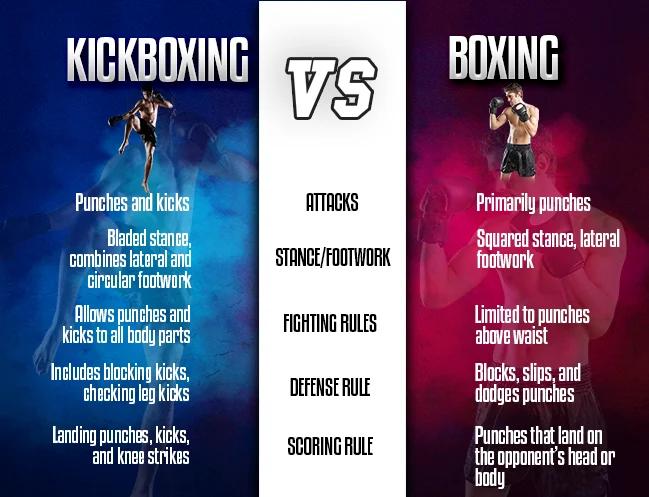
In kickboxing or mixed rules, the kickboxer has more ways to win. Leg kicks damage a boxer’s stance and footwork. The boxer also has no trained defence to these strikes such as ‘checking’ the kick. Knees in the clinch create additional threats. A boxer simply isn’t trained to defend that full arsenal.
However, under boxing rules, those weapons disappear. No kicks. No knees. No clinch strikes. What remains is punching — and punching is the one discipline boxers devote their careers to mastering.
This is where the technical gap shows. Kickboxers typically stand more square to accommodate kicks, which can leave them exposed to straight punches in a boxing ring. Their head movement is usually less refined, and while they can punch with power, their combinations and defensive reactions are not built with the same singular focus as a career boxer’s. Power is the one true equaliser. A kickboxer who carries knockout force into the ring always has a chance. But over multiple rounds, boxing specialisation tends to accumulate.
At comparable levels:
- Under kickboxing rules, the kickboxer holds the edge.
- Under boxing rules, the boxer does.
The rules are not a small detail. They shape the entire fight.
Can a Kickboxer Beat Usyk? The Verhoeven Question
Verhoeven is a long-reigning GLORY heavyweight champion at 6ft 5in with genuine size and power. He has trained specifically for boxing and carries physical tools that would trouble many heavyweights.
But Usyk presents a different problem. His southpaw angles, elite footwork, and conditioning have already dismantled top-level heavyweights. He controls distance, rarely overcommits, and improves as fights progress.
Verhoeven’s best chance would be early aggression — forcing exchanges, using size in the clinch, and landing something significant before Usyk settles. The longer the fight goes, the more Usyk’s boxing pedigree is likely to tell.
Split Decision’s view: Verhoeven has a puncher’s chance early. Over twelve rounds, Usyk’s specialisation should prevail.
© Split-Decision.co.uk — all rights reserved.
Can a Kickboxer Beat a Boxer? FAQ
Has a kickboxer ever beaten a professional boxer under boxing rules?
Crossover wins by kickboxers under boxing rules are rare and tend to involve opponents who are not elite-level professionals. The most competitive recent example was Francis Ngannou pushing Tyson Fury to a split decision in 2023, but Ngannou came from MMA rather than kickboxing and still lost and then lost badly to AJ in his next boxing bout and has not boxed again. At world championship level, pure kickboxers have not beaten professional boxers under boxing rules.
What is the biggest advantage a kickboxer has over a boxer?
Under mixed or kickboxing rules, the range and variety of strikes — leg kicks, body kicks, head kicks, knees — gives a kickboxer a significant advantage because they can attack from angles and distances a boxer cannot respond to. Under boxing rules, that advantage disappears entirely. The kickboxer is reduced to punching only, which is the one area the boxer has spent their entire career developing to an elite level.
Does Rico Verhoeven have any chance against Usyk?
A puncher’s chance, yes. Verhoeven is physically imposing at 6ft 5in with a 78.7-inch reach and genuine knockout power. His best path is early aggression and landing something significant before Usyk settles into his rhythm. The longer the fight goes, the more Usyk’s boxing technique takes over and the less Verhoeven’s kickboxing credentials matter. However Usyk has never been knocked down, let alone knocked out so would require an immense amount of power.

Ben is the founder and editor of Split Decision, an independent boxing news site covering world title fights, British boxing, and boxing products.